Imagine

It’s been a while between posts. I’m almost ready to share what’s been happening in my head lately but until then this old piece will have to do.  It was John Lennon’s birthday yesterday. Before the date fades again for another year I decided to drag this old piece out, which was inspired by his memory. It was written so long ago, in another country and what feels like another lifetime ago. Re-reading it now, it’s still relevant. Sadly, not much has changed. So happy birthday John Lennon, 74 year-old that you would have been had our world not have been so fucked up. Let’s be reminded – today, tomorrow and again the next day –  to try and stop fucking things up any more than they have already been. Imagine away people x

I only managed to see about 15 minutes of the 11th memorial for Yitzhak Rabin’s murder. I had confused the starting time with the time of Aviv Geffen’s appearance…so made it just in time to watch him sing the same song he sang 11 years ago, minutes before Rabin’s death. The words came on as I made my way through the crowds. This year, the Clintons weren’t invited to speak. Neither were any politicians. They could come to participate, but not to take advantage of the crowd in order to spit meaningless promises at their audience, whose patience and energy were dwindling. As I moved towards the front of the stage I noticed the people around me. Last year, at the 10th anniversary of Rabin’s death, the city square was packed with 250,000 bodies; international journalists, people of all ages, cameras, banners, balloons, candles…this year it was as if only the real stayers came; only the ones who really meant it, with or without Bill Clinton’s speech. This year there was a lot more space to move around, and a chance to really see the faces of the people. As Aviv Geffen left the stage and a young girl came on to sing the national anthem, I realized that I had missed David Grossman’s keynote address. He is a well known left wing author, whose son was killed in Lebanon the day before the cease-fire… I realized I’d almost missed the most intense dose of peace and love available in this country. The presence of the people around me (singing the anthem) has been growing thinner and thinner with every year that passes. It is so hard to talk about peace here, to still believe that it may happen one day. But thank goodness for these people who still manage to find a way to believe. I looked around and understood that the future of this country depends on them; nothing else would make a bigger difference. The memorial ended. People kept standing. No one wanted to leave. The song that Rabin himself had sung at the peace concert 11 years ago came on in the background – Song of Peace. Everyone seemed to be in a sort of daze. They slowly started dispersing, miming the words of the song to themselves, as if in some weird kind of dream state. Then groups of people began moving faster and dancing to the music. It was over, for another year. Lots of people kept standing there, staring at the crowds, not wanting to go anywhere. And then there was what Alanis Morrisette may have described as an ironic moment (but I would just call it a strange coincidence)…Imagine by John Lennon came on. People quickly swapped the words they were mouthing for the words to Imagine. I was still taking it all in in the background. Suddenly, the CD started jumping. The words became muffled and twisted and broken. Then, just like that, the song died…just stopped!!! I burst out laughing, along with a woman who was standing next to me. She read my mind and said “It’s too hard to even imagine it anymore huh?” On that note I turned around and started walking home. I’d caught a glimpse of the peaceful people in this country at least. I’d get home to see how many people in Gaza had been killed over the weekend. I’d have to watch the once centrist government slowly but surely turning right wing again. I’d have to keep wandering what would happen next for the rest of the year…but I would have in my memory all those people who turned up in the cold and the rain to give peace a chance once again. And if David Grossman, who had lost his son to war, could still stand up there and plead for it…maybe, maybe – I thought – others could be convinced to do it too.

(2006)

My comfort zone

My comfort zone

 the national geographic shot

Apparently I look twenty six and Mauritian. Those who know me would giggle kindly at this description. The passenger on the train this morning who relayed it to me thought he was being sweet, I guess. I just want to get home. Disinterested in his small talk, my quiet demeanour hopefully came off as shyness. It is too early in the morning, I am stuck without a car unexpectedly and I need to start my day. That’s all. I do not want to talk about the great weather, or the up-coming football season or the traffic. I need to get from A to B and this train ride was not in my plan. There’s something about the phrase public transport that either does it for you or doesn’t. When it’s brought up in conversation the debate that follows has the potential to leak into all sorts of political and social realms. Almost always though it comes with stories of excruciating experiences of having to deal with other humans who’ve inadvertently stepped into your comfort zone. On a different day I would have welcomed the chance to speak aimlessly about nothing for a while to someone I didn’t know and didn’t have to worry about. Today the fact that I don’t has left me with a feeling that lines my insides with guilty frustration. 

A few years ago I took a  photo I affectionately used to call the National Geographic shot. Look what I’ve captured, I proudly thought to myself. I even thought I’d seen the image before somewhere; the two women seemed to epitomise my expectations of beautiful and exotic. Back then my eyes skimmed past the reality but years later, as I sit here with my time on this train,  I find the vision back in my thoughts. They were two women without space to breath. Two women who could not avoid the smell of each other if they wanted to. Two women whose faces pressed together as the weight of the people behind them pushed them so close that they could almost taste each other. Two women who were not friends. Two women who had no room for small talk. One woman, with her hair brushed and pulled back neatly and some makeup applied to her face; her finger sporting a shiny ring  – was off to work. The other whose exhausted face showed the lines of her harsh life, was off to somewhere. The window next to them was open not only to let the air in; as the women hung out of it they were so thankful for the extra inch of space it ever so slightly provided them. This would be the only bus for hours. Miss it and they would be late… If time is what mattered to them.

Recently I have begun considering space; the fuss we make about it, how much we take it for granted, how we either attract or repel others towards our own personal invisible circle, which we shrink or expand accordingly. My thoughts drift back to that bus stop in Northern India. If I close my eyes I can see all the other things that were on the bus; chickens, goats, boxes, cages, bags – all forced to find a space between the people. I remember that when I tried to board the bus myself I was politely told that this transport was only for locals, not suitable for foreigners. My bus would be coming soon.

It makes me wonder why I was not allowed on the bus. Was it because I wouldn’t be able to cope with the lack of personal space? Do we take space too seriously? Are we too precious about it being invaded? I take a more scrupulous look at the photo in my head and I feel a sense of closeness between the women; they will push up against each other and in doing so offer a support that I would not be able to ask of anyone on this entire train. It suddenly occurs to me – I am sitting here all alone. Comfortable in my invisible bubble of space.  Giving off vibes of ‘do not come closer’ and ‘do not initiate conversation with me because I don’t have time for you’ to anyone who glances in my direction.

As my heart-rate begins to increase with thoughts of my kids and partner waiting for me on the other end of my train journey; as lists of chores begin piling up in my head alongside work, school and everything else I am running late for, my reality hits me: I have my own stack of things to fit into spaces on my own bus. And here I am, standing in my comfort zone at the train stop. There is no one for me to push away from or push up against or reach out to and feel close enough to ask for help.

Crying in a different language

unnamed (3)

Today I woke up to some awful news that made me cry tears I didn’t know what to do with or where to put. Where do we put the emotion that erupts when life gets a bit too much to take? How do we wear them so as not to seem shallow or fake? When the world around us has gone crazy where can I put my tears cried for someone I knew such a long time ago?

The first time I realised that emotion was something I could never control was when I cried in a different language. The tears ran down my face and I wasn’t even sure why. The words that I could only grasp on the surface  had touched a place inside me that I immediately understood was a domain I could never completely comprehend even though it lived inside of me.

Something similar happened this morning. After being told of the passing of a person I was once friends with my body at first froze. Once the news sunk in the tears began to fall. I hadn’t seen or spoken to this person for so many years but all I could see was her shining smile, her big white teeth and her cheeky eyes. Although so much time had passed since we had last spoken she is someone who finds her way into my head more often than she will ever know. Just a few weeks ago I was cleaning out my cupboard and came across a shrunken brown Bonds t-shirt. I don’t remember why but it reminded me of Danya and so I kept it. Now it seems like such a strange thing to have happened. And now that will become my little piece of her. The t-shirt that conjures up memories of call centres, laughs and silly conversations.

I carried tears around with me all day today.  I carried them for the fact I hadn’t spoken to her in such a long time. I carried them for the fact I didn’t know she was suffering. I carried them for all the other lost connections my life has been a part of. I carried them for all the connections I might still lose for no particular reason other than we all have so much to be busy with we get lost in our own busyness and forget to take people with us on our journey. I carried them because even though we know that life is too short – so many people repeat that phrase so often – we still spend too much time worrying about the details that won’t matter.

So I decided to put my tears here on this page. There is nothing I can do for Danya any more. There is no way I can even say goodbye and tell her she was often in my thoughts. I can’t tell her that she’s one of those special people who walk into a life and leave a mark, because not everyone does. I can’t tell her how sorry I am. All I can do is write these words and remind myself of the beautiful people I have around me who I will try to hold on to and carry with me for as far as I can take them.  My tears today did make me feel uncomfortable at times. In any event they came from a real place inside me, where all the messiness piles up to be sorted. And although I can’t quite find a place for them yet, putting them here to breathe for a while feels really good.

The picture of the woman who gets me up in the morning

IMG_0083

Today I was called an arrogant bitch. I was driving in my car when my thoughts overcame me at the traffic lights. As I dawdled  into things that had happened to my life recently an unfocused moment became reason for the man in the car alongside me trying to make a turn as quickly has he could to not only make assumptions about me but to verbalise them in a way that was harsh enough for me to have to carry them and analyse them as the day continued. During my undergraduate Arts degree of varied description I came across feminism and even found myself taking subjects called ‘women and power’ or something like that. I don’t wear make up on most days. I’m a mother whose children may not have a clear answer for the question ‘what is your mum’s job?’ yet the fact that they are asked this question at all allows for some degree of satisfaction; some proof of progress. I whinge. I get labeled; I have been objectified. I complain about life and inequality. I am not always happy. I don’t spend my days feeling blessed that I can walk down the street by myself or even indulge in a drink at a pub during the day – on my own.

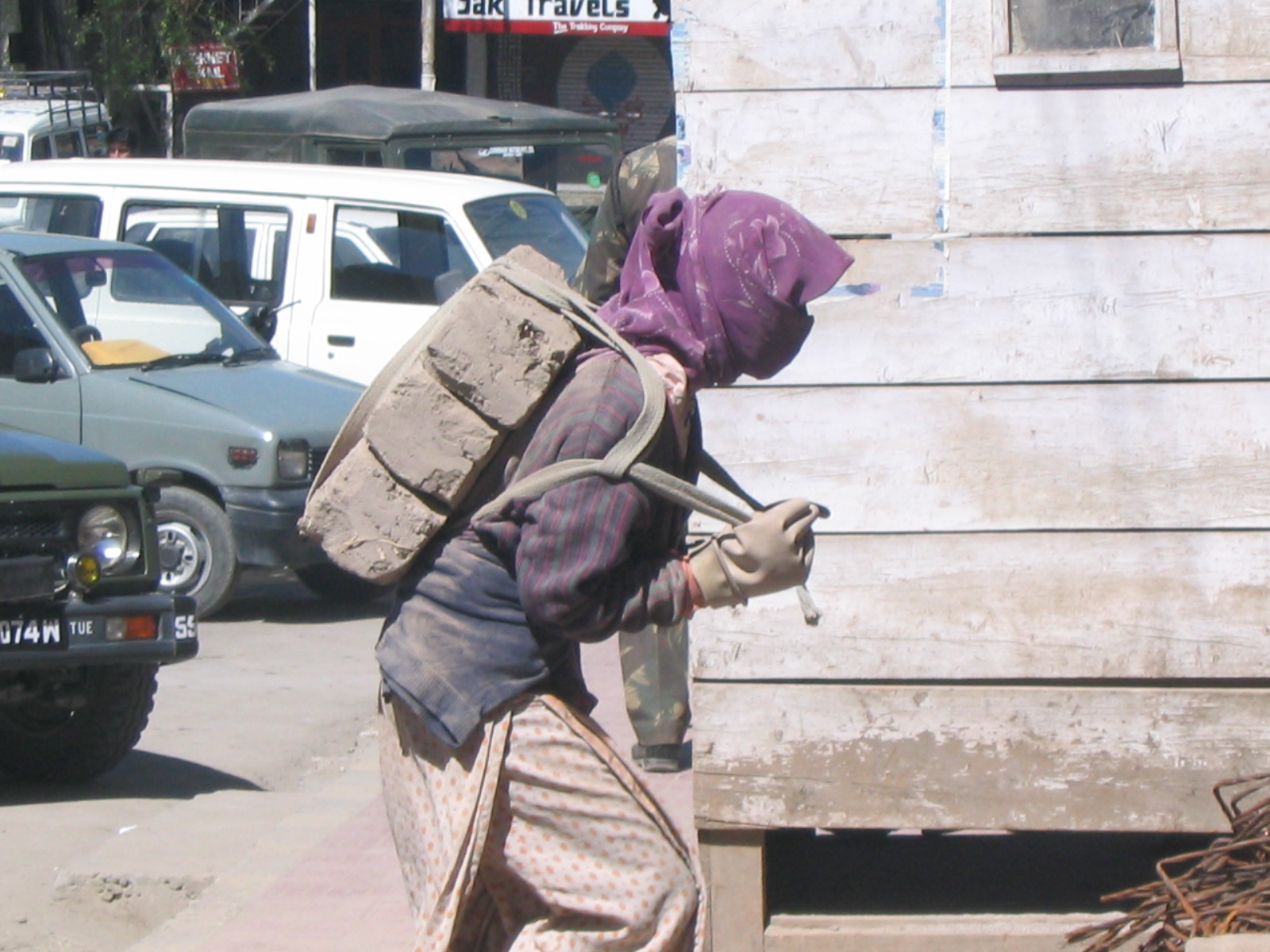
When I took the photo above I was aware I was stealing something. The woman whose life I dived into for a few moments – uninvited and unashamedly –  remains anonymous. I took the photo because at first I didn’t believe what I was seeing. I remember standing, frozen and frightened for a few moments while I gathered what my eyes were trying to capture. Across the dusty unpaved street in downtown Ladakh a woman hobbled slowly; her back bent over by the weight of the bricks it was carrying.  Her hands and face were protected by rags. Although I couldn’t see her eyes I could feel her shame. She did not look up or down. She did not glance sideways towards my direction. She knew I was there.

Here, here’s my life. Here’s my feminism. Here’s my lot. I carry cement bricks to building sites each day because where I’m from women do the hard labour. Women do not get to make decisions about make-up free selfies. Women do not get to decide about what to make for dinner, what else to put in school lunch sandwiches that become boring soon after first term ends. Women do not get to drive cars and be called arrogant bitches; or walk down streets in fancy clothes and get wolf-whistled at. Here feminism  – if that’s what you want to call women working – is meaningless for me. Do you want to be treated like a man and have your back broken?

Sometimes the mornings are so monotonous they lull me back to sleep; the morning drill. The fighting children. The rush to do everything and more. The ridiculous expectations we have of ourselves. The domestic crush of the soul. The anonymous woman in the photo finds her way back into my thoughts on these days in particular. As her image confuses and destroys everything I thought I knew her predicament challenges me in such an immense way it forces me to get up and try to make sense of all our realities as they naively collide and stupidly compete with each other. She may still be stuck in her reality. I am often stuck in mine. Yet even the thought of hers during my day-today so-called privileged life is what makes me believe that one day, somehow, our two realities will meet. Her bricks will fall, my complacency will be shaken and we will both be called women.

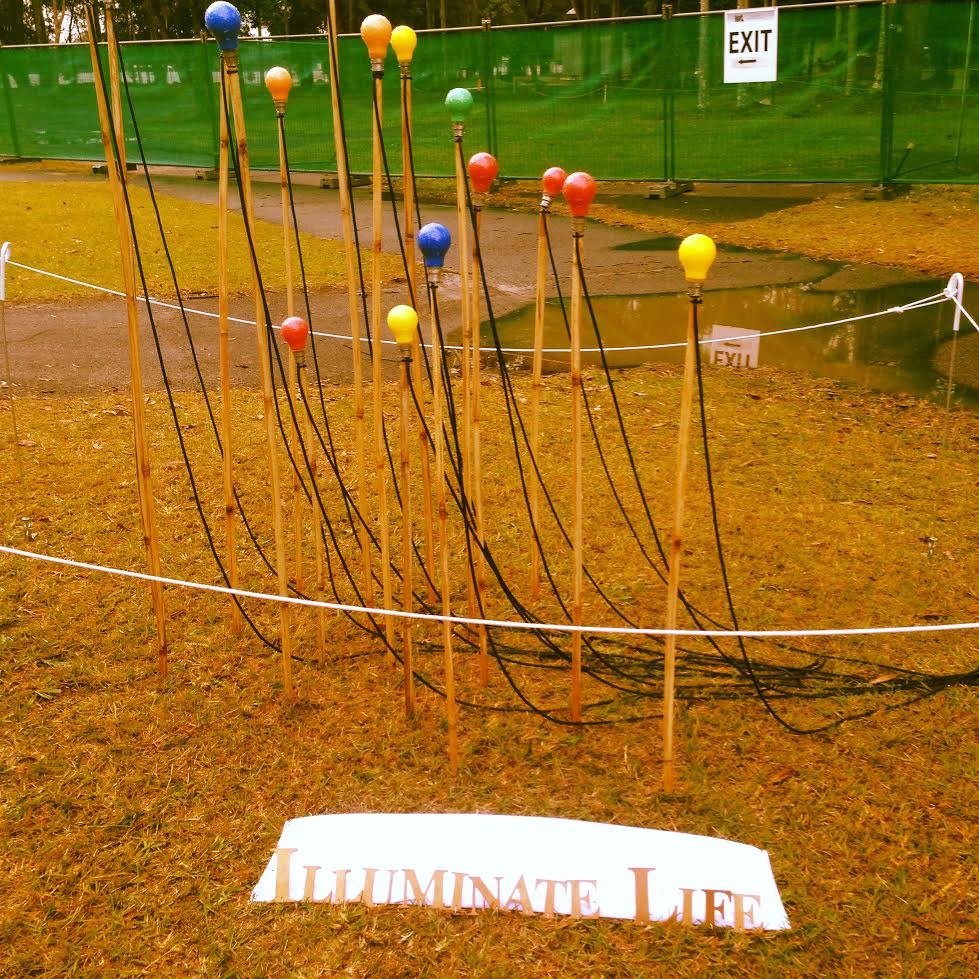
Gone Illuminating. Be back soon.

I have just returned from being immersed. I don’t refer to anything religious with my choice of conjugated verb.

My immersion began when I arrived in Byron Bay with one initial mission: to find the flotation tank that had set me on a cloud of care-free some fifteen years ago when I first discovered this mode of relaxation that was unlike any other I could have imagined. Lying in a coffin half-filled with salty water is not everyone’s chocolate. And think what you will for my confession that it’s my idea of heaven.

So when I found my zero gravity coffin box at a place called Relax Haven I knew it was only a matter of time before further immersion would be allowed to occur. First I needed to release the layers of fatigue, dust, dead space and worry that had edged their way under my skin and remained in the creases hoping to find a permanent home amongst my angst. As I lay down in the warm, magnesium-activated water I said ‘sorry loves, you’re leaving’ and closed my eyes for an endless hour of trying to go nowhere in my own head. For most of the hour I did manage to find nowhere. After what seemed like a period of fifteen minutes my time in the tank was over and my journey could begin.

unnamed (2)

The next three days at Byron Bay Writers Festival 2014 were filled to the brim with whole food, fine weather and full words.

I feel slowed down, filled up and let out.

Jeanette Winterson said ‘where do we meet? We meet on the steps of a story’ and in doing so reminded us all that language is what started us, language is what ties us together and language is what makes us human. It’s often so easy to forget that little line –  ‘we are all human’ – it’s so obviously simple that it’s so easily kicked away to the sidelines. She said

“If you think about language beginning in the mouth rather than before it hits the page, because speech is far older than writing, language itself becomes a memory system, a way of passing on and preserving what is essential to remember, the history of a tribe, clan, a people, enchantment, celebrations, warnings, heroism, doomed lovers, loss. In that sense storytelling allows history to happen.”

and immediately reminded us not only of our present, but of the past in all our futures. And in that complexity we find ourselves. We need to embrace the complexity and not let it scare us into unconsciousness. In slowing down and listening to the stories told all around us, we need to let our minds immerse themselves in the language that binds us.

Jeanette Winterson was one of so many writers who reminded me so gently what it means to be a reader and a writer. ‘Reading…’ she said ‘takes your hand off the panic button.’ And I had had my hand on or around that panic button for far too long. The circumstances of my life had forced me there. Now, Winterson and her words were showing me how to remove it. For that I cannot be more grateful.

unnamed (3)

At a book signing after her address Jeanette Winterson touched my heart…and I like to believe I touched hers as well. As everyone lined up with their  pile of books for her to sign, all with sticky notes attached clearly spelling the accompanying  names to make things easier for the signer there was one book that remained unnamed – mine. As she reached this book Ms Winterson asked ‘and who’s this one for then?’ I smiled shyly and said ‘that one’s for my daughter…who’s six years old.’ She looked at me with wide eyes and I explained ‘you see, I might never see you again! And so I hope that in ten or fifteen years time, when she’s old enough, that she’ll pick up your book and read it as I did.’ And as I tried to get the words out as calmly as possible, she put pen to paper and wrote a little note for my daughter. She looked up at me and I could see her eyes glimmer. Mine certainly were. I said ‘thank you so so much’ and walked away with the best gift I had received in a long time.

After Jeanette’s remarkable introduction the rest of the festival flowed on like expensive champagne, straight into my glass. Three days later I emerged, drunk, spent and reignited.

“A lot of people say they don’t have time to read any more,” she said. “That should be a warning sign, not a fact of life.” (JW)

I’m back 🙂

The hole in my leg

Last night I had the strangest dream. I was back on the kibbutz, lying in bed with you… We lay there laughing and talking. We had been lying there for weeks, maybe months, and neither of us felt any urge to get up. It suddenly occurred to me that there was something on my right ankle or just above it. I looked down to find that my skin had folded over and made a crease because I had been lying down for so long. When I straightened my leg and the crease of skin ironed out there was a huge, perfectly circular hole in my leg. The skin had been torn and all the flesh eaten away at. I stared at the hole, intrigued by its precise hollowness. I realised it had all started from something beautiful. A beautiful butterfly had flown into the room and found a spot on my leg just above my ankle bone. Somehow, as I was lying on the bed, it became trapped. As weeks passed by and the skin folded over it, the butterfly began eating away at my flesh. Now all that remained was the hole. You assured me that once I stood up and started to move again the skin would grow back and the hole would fill in. But neither of us wanted to get up. As I noticed the hole in more detail I became more fascinated by it.

Complacency is a dangerous friend to have. In its safe familiarity it offers comfort and warmth, yet invite it in and it will not get up from your couch. Offer it a drink and it will invariably overstay its welcome. It often comes disguised as the exact thing you had been searching for so long; your chance to escape vanishing before your eyes once you recognise it for the exact thing you had been trying so hard to avoid. Two people meet and in the flash of that instant their lives change forever. They lock hearts and minds, often through no choice of their own, and a chain of events is suddenly set in motion. There is no way of knowing how bad this choice of friendship will be in years to come. There is no way of foretelling how badly they will hurt one another; how desperate they will become to rid each other of their own memory. The dangerous complacency will set in amongst them both and for a period of time, perhaps even years, none will be the wiser. Until the day comes when they find themselves filled with such hate they will be unrecognisable to others.

Tami and I never actually met officially. We were born in the same year on the same kibbutz in the northern part of Israel, where the Sea of Galilee meets the Jezriel Valley. Our parents had arrived at the kibbutz within years of each other, from South Africa. Unaware of each other’s existence in South Africa, once they were acquainted in Israel our two families connected instantly and became close friends, offering each other support and comfort during the initial difficult years of settling into a new environment. Tami and I were born within months of each other. For years I was fed stories of how we quickly became inseparable once we reached the age where we began noticing existence of life beyond our own mothers. There are countless snaps of memories to prove this fact. Starting from the day I rolled over onto her, followed by the glints of smiles our parents wore as we both rose from the floor. Tami and Tali. Sure to be friends for life, if only because their names both began and ended with the same letters.

Convenience is another silent killer. It creeps up on you even when you’re wide awake and aware. You realise that the only reason you accept its invitation is easiness, and laziness, and you convince yourself there’s nothing wrong with that. Why should we make life more difficult for ourselves? Why should we always be looking for the harder, less travelled path? How many people seem to walk through life unconsciously, with their eyes half closed, somehow always seemingly making it through to the other side with painless ease and grace? Why, god dammit, can’t you be one of those people just for once, you ask yourself.

Mum was never really a good judge of anything. Of course I only learnt this gradually and only decided to embrace it as an adult. During my childhood it was a flaw that I often found myself making excuses for. I grew up feeling sorry for my mum. I felt bad that she had left her own family behind to come to Israel and make a new start with dad. I felt bad that she had left all her childhood friends and memories and start again. I felt bad that at the age of 23 she had to learn a new language for the first time in her life. I felt bad that she always talked about what was missing; what had been taken from her – the incredible life she had left behind filled with riches, comfort, good friends and expensive clothes. So I guess my compensation was myself. I put myself after everything; her, her needs, her grudges, her guilt. I learnt to hide in shadows from a young age. I sat behind, I stayed behind, I kept quiet. I became a really good listener as a result. Nodding was a refined practice of mine. I agreed to everything because the alternative was to cause her even more sorrow. Tami was one of the things I never questioned. As I ensconced myself in her shadow, my friendship with Tami solidified mum’s friendship with her parents and thereby gave her security in return. The kibbutz was the kind of place that looked wonderful and warm from the outside in. Once you stepped inside and noticed all the cracks and dysfunction, you realised quickly that to resist it was futile. In order to deal with the daily dose of mad normality you needed good friends around you constantly. Often this meant hiding in each other’s shadows as you walked around.

Acceptance is the third in a line of evil friends to have. It’s the hardest one to befriend because it signals the end of independence. It’s also the hardest one to resist. It flirts with you as it shows you how easy it can be. It plays with your head as it parades past taunting you with things you could have or could be or could do. And as it goes by it bulldozes the path less travelled that you look onto as you realise your time has passed. It dazzles you with materials and fools you with glittery visions of how life should be. And as it takes its final bow the door bangs shut and you are stuck there. All you have in front of you is a mirror with you as reflection, taking your final bow. It is only when the pain becomes too much to bear; when the longing for yourself and what you used to look like becomes so overwhelming; when the hurt has stung a hole so deep it touches the edges of love slightly enough for a spark to trigger inside and a memory of what love once felt like that you will finally get up and do anything in your power to kick your new friends out. All three of them.

You many wonder why I’ve chosen to tell you this now. You may think it unfair or biased or even immature of me to reveal these inner thoughts of mine at this particular juncture in time. And it’s unfortunate that life made us meet now and not at some other more suitable point. But as I’ve passed through various places I’ve slowly realised that not everyone deserves a place in my heart. Not everyone gets to stay a while. Perhaps you didn’t expect to read it in a letter. Perhaps you were waiting for me to visit you in person and say it to your face. There is no way you could have known what the mention of her name does to my insides. I don’t blame you for a second nor do I think any less of you for it. What I need you to understand is that I cannot go back there, not ever again. It took me years and years to fill that hole. It took me hours of convincing myself that I would eventually be all right. It took me days and days to get up and walk again. It took so long before someone else stopped to ask if I was okay as I stumbled my way down the path. You were the first person I trusted again. You were the one whose rich soil lined the final surface of my wound before the skin grew back to conceal it. Although things didn’t work out for us romantically I treasure your friendship like the most precious stone. I will keep this stone close to my heart forever. Sometimes life does things to convince me that there is no such thing as a coincidence. I am at a solid place now and you have given me all that I need to take. Go to her and be happy, but I cannot come with.

Pearls are what you get from those who love you. So that you can take them and rub them until they shine. After you have treated every single one with the love you feel in return, use them to fill up your hole – hollow and eaten-through, raw and empty. And when it is full to the brim you will appreciate the strength you gained both from the gouge you received and the pearls you used to repair it. Last night I had a dream, but after writing you this letter I realise it wasn’t strange at all.

The other brother

He would invariably be cold at first. We had a routine going and he would hold me to it to precision before he ever let down his guard. Some days it didn’t matter if I performed all the rituals or not. He would remain closed, hidden; sealed with anger. His mother would often pass by his bedroom without our knowing. Sometimes I would turn around and see her standing there, watching us. Her eyes appeared vacant yet focused – on what I could not be certain. She would be deep in thought and my glance would startle her. She would then bounce back, shake her head slightly and walk away. On days that she didn’t watch us she would spend stuck in her armchair reading through her papers of school work to correct, examine, edit, translate; critique. She always seemed to have something important to do that needed her urgent attention as soon as I arrived, which is why she couldn’t stop to chat. Sorry, I’m sorry…come inside. You’ve caught me in the middle of something. Alon is in his room; he’s been waiting for you.

Without fail Alon would be waiting for me. In his tiny room in a pokey flat in Tel Aviv he was told to wait for me, patiently and respectfully. His mother ran through a list of exactly what he was and wasn’t to do in my company. Her frequent offers of chocolates and home-baked biscuits to ‘sweeten the lesson’ as she put it didn’t disguise her false kindness profusely enough. She constantly needed to find a way in, to be involved without seeming to be involved. She needed to know everything that was going on between her son and me – she had ‘to approve of things’ she said. Approval was only a small part of the reason why she behaved the way she did. What she really needed was to connect. She tried to connect with her work, with her piles of paper and important sets of tasks. She had lots of colleagues who she attempted to connect with through feigns of common ground. She would spend hours researching people before approaching them and refined the art of inconspicuously including random bits of relevant information into conversations that would often lead to profound friendships as a result. And as a result she seemed to connect. Yet none of it really mattered because the only person she genuinely wanted to connect with was the one person who was proficient at cutting her off; her own son.

I spent one hour a week with Alon and it was often the most excruciating hour of my day. In fact, looking back, I dreaded my time with him. I would force myself to prepare for his lesson, finding the force I brought on myself the only element of challenge that kept me going back for more week after week. Like a sick dog I would go back for more bad food. And then I would begin to eat grass in the hope that someone would notice this universal sign of sick dog behaviour and help me. Instead, people walked past preferring to be blind to what was happening. This self-inflicted pain carried on for months and months without pause for comment or question.

Every week I would creep into his room to find him staring out the window. My footsteps didn’t seem to matter. I would carefully sit down beside him making sure not to end up too close to his person – after all I was his tutor. I would wait there patiently, holding my books and finding a comfortable position in the chair, until he was ready to let me in for the hour. Sometimes he would start talking without any need to prompt. He would tell me about his day with a desperate look in his eyes. They were dulled with sorrow. It didn’t make any difference whether he was smiling or laughing – his eyes were sad. Occasionally he would talk to me as a friend or at least someone he could tolerate but those moments were so random and infrequent they hardly stand out in my memory at all. Most days I would feel his anger rising up before I walked through his doorway. He would have his back to me every single time. After a while I could tell what sort of mood he was in just by looking at his back and how it was arched; which muscles were tensed, where his hands were, which direction his head was pointing in. I became an expert in reading body language thanks to Alon. It is a skill I thank him for to this day. I whisper words of thanks in my head hoping he can hear them somehow.

Week after week I would let him berate me. I would sit there and give my confidence, my joy, and my happy disposition over to a twelve year old boy who would in turn watch my eyes scorn as he tore each one up individually, slowly and skillfully. My mouth did not flinch. I would hold it still and tight as I watched him back. He was a true master of his work. He had trained himself to hear his mother’s footsteps from a young age. It did not matter if she was barefoot or wearing soft slippers he would switch to Alon the twelve year old as soon as he suspected her ears were listening.

On the last day I ever saw Alon I arrived at their flat a little earlier than planned. It had been pouring with rain that afternoon and I had taken advantage of a dry patch in the weather to walk over to the other side of the city as fast as I could before the rain started again. As I approached their building I slowed my pace down, realising I was way too early to walk upstairs and knock on the door of the home of people who often raised my hairs at the thought of them. His mother’s silent footsteps were starting to freak me out and I was beginning to tire of the exhausting sessions with Alon which involved hardly any English language learning and a lot of what I have now come to believe was a weird version of psychoanalysis. I was sitting at the bottom of the stairwell when I heard a door opening upstairs and a male voice emanating from inside.

I had only met Alon’s father once yet I knew straight away it was not him talking. Before I could get up and pretend to not be there at all the man and Alon’s mother were downstairs. They had used the lift. The man hobbled out of the lift and as my eyes honed him I realised he was quite young and missing a leg. He came towards me using his crutches and then stood right in front of me, waiting for Alon’s mother to catch up to him. I noticed an army symbol on the pocket of his shirt that I thought signified the paratroopers unit although my memory was rusty. As she crept towards me her hesitation overcame her and she stopped halfway between the lift and the man on crutches. It is wonderful to meet you, he said. I have heard all about you. Oh, I muttered, who are you? Before he spoke any further he turned to look at Alon’s mother who gestured tacitly with her head and eyes. I’m a friend of the family…a close friend.

Although they shared a bedroom I had never met his little sister. She was always out during our lessons; at a friend’s house, at an after-school activity. Yet the bedroom was covered in her. She had noticeably begun taking over any available space. All that was left for Alon was the corner where his bed lay and the one wall that it backed onto. I was not sure how much younger she was. I didn’t like to pry and neither Alon nor his mother ever spoke about her. From the collection of Disney paraphernalia and other mass produced items that plastered most of the interior I guessed she would have been about six or seven years old. Her possessions were so colourful and cumbersome that they would often distract my attention at the start of our lessons and it would take me a few minutes to block them out and focus on Alon.

On that last day it was as if Alon’s sister had suddenly vacated the room. I had come upstairs while his mother was saying goodbye to their friend. I walked towards his bedroom listening carefully for any signs of upset or a particularly bad mood that might help me to ease into the lesson a little more smoothly with prior knowledge of what to expect. When I heard whimpering I felt goose bumps on the skin of my arms popping up with a lack of any control. I tiptoed the rest of the way and stood at the doorway until Alon could feel my presence. Although he didn’t turn his head I could tell he knew I was standing there. He wiped the tears off his face with his arm and then continued to stare straight ahead. I walked in and sat down in my usual position.

Who was that man? I asked abruptly. The mystery surrounding his visit and connection to the family had begun to eat away at me at a fast pace. As I heard myself repeating the question I looked around the room, hoping something would distract my focus and let me get lost in its colours for a while so that the tension between us could dilute. It was as if the walls had been painted stark white and all the silly clutter removed. My eyes wandered around and around as I made attempts to block out the verbal bashing I was receiving from Alon. And then my eyes found something. Had it been here all this time? I tried to search my thoughts but nothing matched up with the lonely photo that was stuck to the wall just above Alon’s bed. It was a photo of an adolescent boy in army uniform. He had a proud, thick smile on his face. I tried to speak but all that came out were tears. They rolled down my face as I stood up and ran out the room, out the front door, down the stairs and all the way home.

The rain poured down as I dragged my heavy heart through the streets, between the noise, around the stress and over the panic until I reached my front door. When I found quiet at last it was as if the heaviness had escaped from my heart and was now pounding down on me. It pounded until it beat me to the ground. I lay there, flat on my back, staring at the roof of my bedroom. All I could see on my plain white ceiling was a clear photo of the face of the boy on Alon’s wall, whose deep eyes and cheeky smile were exactly the same as his once would have been before the horror came in and stole his childhood. That night I cried until the loss that ached in my stomach drugged me to sleep.

There are days when I think it will never go away. There are times when I can hear his voice so distinctly I almost turn my head to check if he is standing behind me. There are hours that go by where my only thoughts are of him; his passionate outcries, his hateful words, his anger that was really soaked in awful pain and grief. He could not bare the sight of me and I understand that now. Everything about me reminded him of a loss that would never return and so instead he would lash out at me for being all that he wanted back. And then one day I left as well. I left to fill the gaps in for myself. I decided the details bore no significance at all. I left so that he could start to heal the wound I had unwittingly helped to aggravate.

There would be no other brother. There would just be a wide open space for him to fill up with all the thoughts he did not want. My presence only threw them back in his face; in his way. When I would walk into his room he could not breathe. His whole body would tense up as I encroached further and further upon the one place he had left to throw his darkness. His mother had hoped that my mask of English teacher would soon wear off and that instead he would see male friend, just like an older brother. Her plans for connection to her son via me not only backfired they wedged a greater rift between them.

Sometimes when I look back on that stinging time I can see her standing there, in his doorway – his back to her as he sits at his desk staring blankly out the window. She is standing there as still as can be, waiting for him to give her anything at all. She would wait there forever if she could. She would do anything to avoid the wide open space that keeps chasing her around, begging her to throw her dark thoughts into its inviting pit. Her thoughts, as dark as they are, are all she has left of him; her other son.
IMG_1315

What does Henry Kissinger have to do with it?

My grandmother went to school with Henry Kissinger. Although they never really shared anything beyond a class photo it is a fact that remains after many others have disappeared to that place where forgotten memories pile up like stock to be counted. Sometimes I wish I could find the pile so that I could discover other cool facts to share. Yet I know that what ends up in the pile desperately wants to be forgotten forever. There are some things we drag along with us though, despite their ugliness, their bitterness and the pain their memories cause. We pull them along in the hope they will keep us grounded in the place just in-between remembering and forgetting, so that we won’t be dragged down by them – or led astray without them. In reality though my life is so far removed from that of my grandmother’s that the fact she and Sir Kissinger shared a photo once upon a time seems ludicrous to me.

My grandmother also once came home with shit smothered in her hair. She was a beautiful lady and as a girl was tall, voluptuous and vivacious. She would light up eyes with her smiles and when she laughed her whole body would dance ever so elegantly. The only problem was she was Jewish in Germany. So when she came home one day covered in brown manure, smelling awful and crying with shame the fact that she was once at school with Henry Kissinger made no difference at all. This story is one of those memories I drag along with me, hoping it will keep me in that place that stops you from going numb from the senseless bullshit we seem to be smeared in ourselves every day that in turn keeps us from smelling what is actually happening around us.

Janine Schloss' Grandmother

If I look around me I can find lots of similar memories to drag around. I don’t need to look too far to find words like apartheid, Nazi, death camps, survivor, genocide and bloodshed in relation to my recent past. Yet every day, as the news of the world I live in uses words that are associated with my personal lexicon of horrific history; as killings and hate fill the screens of our news broadcasts to the point where it almost appears that the world is exaggerating I feel the numbness setting in and taking over. As the words become louder and seem to be drawing closer my stories about Henry Kissinger feel even more far-fetched than ever before.

This week while the world remembers the Holocaust I will remember my grandmother. She didn’t manage to meet Henry Kissinger again, although she did send him a letter once with a copy of her class photo attached. She did escape genocide though and just like him went on to live a relatively comfortable life in a world so far away from the one she was almost exhumed by. Yet as I remember her, I realise she was one of many and for each of her hundreds more didn’t get away in time. I sit here and think of her and no matter how hard I try I cannot envisage the place her home in Germany became as the Nazi regime set in. It is as far away to me and my comfortable life as Syria, Egypt, Sudan, Ukraine, Afghanistan and North Korea are.

This week people will flick through posts about Holocaust commemoration, just as they flick through updates about asylum seekers on our shores and war-torn places that all blend into one big mess they brush aside and put in a place they can refer to when it suits them to feel politically active. What are human rights? Shouldn’t that be a rhetorical question? On the one hand it seems so crazy to think that they need to be contested at all. On the other hand, as I put pieces of bits of war, bloodshed, racism, senseless killings and thoughtless hate-crimes together with the memory of my grandmother and the fate she was saved from the recent past suddenly morphs into the present and human rights sound like something the lucky few stumble upon.

Yet still this week will pass and nothing will have changed. I will carry on as you will. You might keep in your memory an interesting fact about my grandmother and Henry Kissinger but the world will go on and people will get away with murder. Women will be raped. Children will be tortured. Communities will be excluded. Soldiers will lose their lives. Borders will be crossed in the dead of night offering a glimpse of hope and we will carry on sighing together because the life we take for granted has so many of its own issues and problems that we so flippantly forget how lucky we are. And as hard as I try to actually see Henry Kissinger himself; to see the little boy who escaped Nazi Germany and became state secretary standing in front of me –I cannot. Until I am literally knocked over with a real-life pot I will continue to inhale the apathy drug that puts so many of us to sleep comfortably and enables us to live relatively unaccountably.

When I was much younger I dealt with the harsh realities of war that I learnt about in textbooks with the naïve notion that they occurred in some faraway time when people were monsters intermittently and for a lapse in time didn’t care about each other. That couldn’t happen now, I’d tell my much younger self; people couldn’t possibly let that happen now. And now, years later, as I read headlines of ‘never again’ and ‘lest we forget’, my naivety shines with obviousness. How did World War II happen? Did people get away with genocide simply because it wasn’t televised? What about when it was? What about Bosnia and Herzegovina? What about Rwanda? What about Sudan? What about Nigerian school girls getting kidnapped by the hundreds and used as sex slaves? This is just a brief list of the things we know about – what about the things we don’t know? Would it make a difference? Would you let it happen? What could you do to stop it?

Henry Kissinger, my grandmother and a long line of others were simply lucky. Luck is what saves some and drowns others; it is what feeds babies and lets others starve to death. I have seen how genocide is allowed to happen. It happens just as easily as we switch channels and switch off screens. How do we get away with simply saying ‘oh that’s terrible’ and ‘how can we let this happen?’ How do we walk past indifference in our own backyards and not get knocked over the head by its relevance? We wake up with this drive in our core to change the world and then we go to sleep drunk on the comfort of our own immediate surroundings. We say we care just as quickly as we order another latte and get on with life. We use the same signature to sign a petition as we do to sign a credit card receipt. We say we care. We say we understand. We say our grandmothers were refugees as well. We say our families also arrived on boats. Again we say we care while we thank our lucky stars we weren’t born in that faraway place where people are monsters and nobody cares about each other.