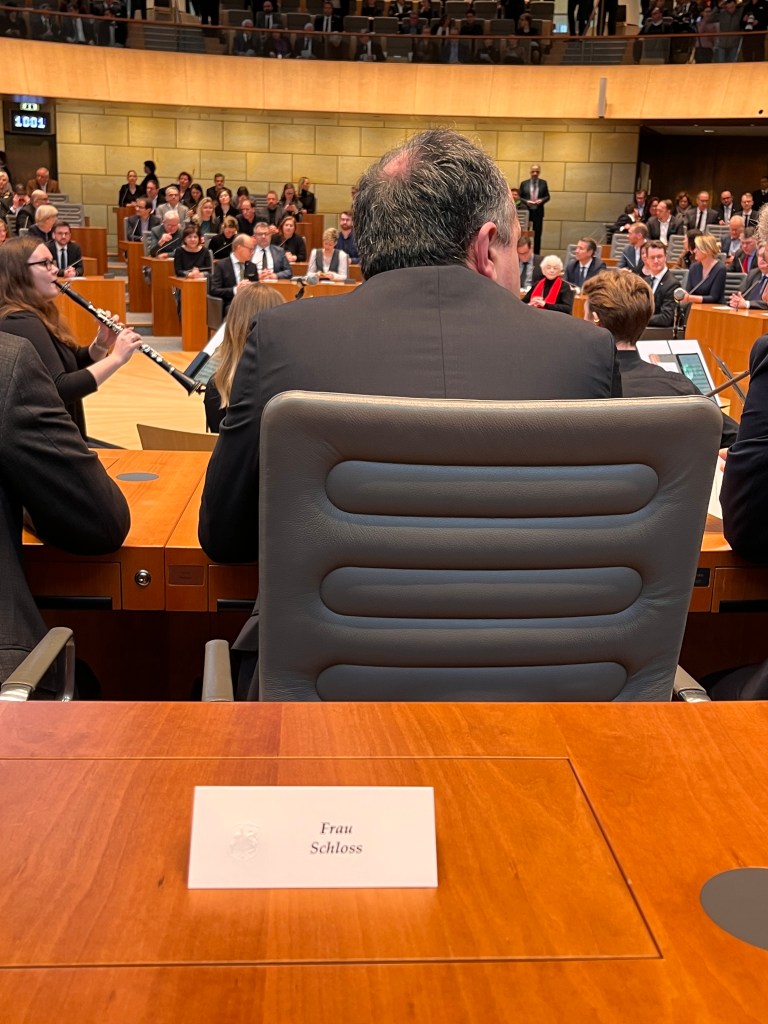
It’s my last day in Germany. My last hours in fact. So, you’ll forgive my trepidation over the prospect of being caught up in a neo-Nazi rally. I’m told those things don’t happen here – not anymore. In retrospect it’s easy to see how I mistook an unfurling football crowd for white supremacists – despite the fact this entire orchestrated journey has been seamless and without incident.
I think back to a few days ago, to my hours spent as Frau Schloss, that day in Dusseldorf. A day spent in the company of my great aunt, who was a graceful dignitary on International Holocaust Remembrance Day, invited by the Landtag of North Rhine Westphalia. It was the day I was allocated a seat in the house of parliament, usually reserved for ministers. The day Prime Minister Wust promised me he’d email me his speech once it was translated into English. (Until then, I’d have to keep wondering what he said with such assertion.) The day distinguished opera singer Pumeza Matshikiza fused the Kaddish prayer with remnants of apartheid, in a room mourning those who perished in World War II, leaving her haunting sound for all to carry home with them, to ponder for a few more days about how, and why and where. The day the students from the Peace School stood in line, waiting to speak to Ruth Weiss – author, journalist, advocate – someone from that terrible period in the past. Yet they couldn’t comprehend how. How she, with so much time to give them, so many words of praise to say to them, so much hope in her voice, could still be here. Nor could I. Her body left Germany in 1936, yet her mind never did. Accompanied by her will, it has pulled her back countless times. For a period, she stayed to live. Now she returns to speak and spread hope.
As I sit here, contemplating how my heart started beating incessantly as I watched rowdy men dressed in black outside the Hamburg central station, gather to chant, letting my mind run to all sorts of places, I think of the words she spoke that day in parliament, to a standing ovation: “Ralph Giordarno has called the post-war silence the second guilt. The increasing hatred of Jews must not become the third guilt!” At age 98 she reads voraciously, writes continuously, thinks wisely, laughs cheekily and above all challenges everyone she encounters to give her a reason to stop. In the house of parliament that day she spoke unashamedly and without hype about the times in the recent past when Germans themselves claimed not to have known about the atrocities of the Holocaust. There she was, standing on the grounds of a country that had turned its back on her decades ago, to deliver her life’s motto: to live in a “world, to conclude with Adorno, in which all people can be different without fear.” That’s where she left her audience – silent, aghast, perhaps a little humiliated at the seeming simplicity of her request.
I remember her words today on this last stop of my trip and berate myself for thinking the worst of the overexcited football fans I saw. I want to keep the words in close reach so that the next time I make assumptions about gathering, noisy crowds, I think instead of the wishes for hope, tolerance, respect and equality with which my great aunt enters every room.
Ruth Weiss is an author, speaker and fighter against racism in all its forms. Her book,My Sister Sara, is available in English.
 wordsetcetera