My comfort zone

My comfort zone

 the national geographic shot

Apparently I look twenty six and Mauritian. Those who know me would giggle kindly at this description. The passenger on the train this morning who relayed it to me thought he was being sweet, I guess. I just want to get home. Disinterested in his small talk, my quiet demeanour hopefully came off as shyness. It is too early in the morning, I am stuck without a car unexpectedly and I need to start my day. That’s all. I do not want to talk about the great weather, or the up-coming football season or the traffic. I need to get from A to B and this train ride was not in my plan. There’s something about the phrase public transport that either does it for you or doesn’t. When it’s brought up in conversation the debate that follows has the potential to leak into all sorts of political and social realms. Almost always though it comes with stories of excruciating experiences of having to deal with other humans who’ve inadvertently stepped into your comfort zone. On a different day I would have welcomed the chance to speak aimlessly about nothing for a while to someone I didn’t know and didn’t have to worry about. Today the fact that I don’t has left me with a feeling that lines my insides with guilty frustration. 

A few years ago I took a  photo I affectionately used to call the National Geographic shot. Look what I’ve captured, I proudly thought to myself. I even thought I’d seen the image before somewhere; the two women seemed to epitomise my expectations of beautiful and exotic. Back then my eyes skimmed past the reality but years later, as I sit here with my time on this train,  I find the vision back in my thoughts. They were two women without space to breath. Two women who could not avoid the smell of each other if they wanted to. Two women whose faces pressed together as the weight of the people behind them pushed them so close that they could almost taste each other. Two women who were not friends. Two women who had no room for small talk. One woman, with her hair brushed and pulled back neatly and some makeup applied to her face; her finger sporting a shiny ring  – was off to work. The other whose exhausted face showed the lines of her harsh life, was off to somewhere. The window next to them was open not only to let the air in; as the women hung out of it they were so thankful for the extra inch of space it ever so slightly provided them. This would be the only bus for hours. Miss it and they would be late… If time is what mattered to them.

Recently I have begun considering space; the fuss we make about it, how much we take it for granted, how we either attract or repel others towards our own personal invisible circle, which we shrink or expand accordingly. My thoughts drift back to that bus stop in Northern India. If I close my eyes I can see all the other things that were on the bus; chickens, goats, boxes, cages, bags – all forced to find a space between the people. I remember that when I tried to board the bus myself I was politely told that this transport was only for locals, not suitable for foreigners. My bus would be coming soon.

It makes me wonder why I was not allowed on the bus. Was it because I wouldn’t be able to cope with the lack of personal space? Do we take space too seriously? Are we too precious about it being invaded? I take a more scrupulous look at the photo in my head and I feel a sense of closeness between the women; they will push up against each other and in doing so offer a support that I would not be able to ask of anyone on this entire train. It suddenly occurs to me – I am sitting here all alone. Comfortable in my invisible bubble of space.  Giving off vibes of ‘do not come closer’ and ‘do not initiate conversation with me because I don’t have time for you’ to anyone who glances in my direction.

As my heart-rate begins to increase with thoughts of my kids and partner waiting for me on the other end of my train journey; as lists of chores begin piling up in my head alongside work, school and everything else I am running late for, my reality hits me: I have my own stack of things to fit into spaces on my own bus. And here I am, standing in my comfort zone at the train stop. There is no one for me to push away from or push up against or reach out to and feel close enough to ask for help.

Crying in a different language

unnamed (3)

Today I woke up to some awful news that made me cry tears I didn’t know what to do with or where to put. Where do we put the emotion that erupts when life gets a bit too much to take? How do we wear them so as not to seem shallow or fake? When the world around us has gone crazy where can I put my tears cried for someone I knew such a long time ago?

The first time I realised that emotion was something I could never control was when I cried in a different language. The tears ran down my face and I wasn’t even sure why. The words that I could only grasp on the surface  had touched a place inside me that I immediately understood was a domain I could never completely comprehend even though it lived inside of me.

Something similar happened this morning. After being told of the passing of a person I was once friends with my body at first froze. Once the news sunk in the tears began to fall. I hadn’t seen or spoken to this person for so many years but all I could see was her shining smile, her big white teeth and her cheeky eyes. Although so much time had passed since we had last spoken she is someone who finds her way into my head more often than she will ever know. Just a few weeks ago I was cleaning out my cupboard and came across a shrunken brown Bonds t-shirt. I don’t remember why but it reminded me of Danya and so I kept it. Now it seems like such a strange thing to have happened. And now that will become my little piece of her. The t-shirt that conjures up memories of call centres, laughs and silly conversations.

I carried tears around with me all day today.  I carried them for the fact I hadn’t spoken to her in such a long time. I carried them for the fact I didn’t know she was suffering. I carried them for all the other lost connections my life has been a part of. I carried them for all the connections I might still lose for no particular reason other than we all have so much to be busy with we get lost in our own busyness and forget to take people with us on our journey. I carried them because even though we know that life is too short – so many people repeat that phrase so often – we still spend too much time worrying about the details that won’t matter.

So I decided to put my tears here on this page. There is nothing I can do for Danya any more. There is no way I can even say goodbye and tell her she was often in my thoughts. I can’t tell her that she’s one of those special people who walk into a life and leave a mark, because not everyone does. I can’t tell her how sorry I am. All I can do is write these words and remind myself of the beautiful people I have around me who I will try to hold on to and carry with me for as far as I can take them.  My tears today did make me feel uncomfortable at times. In any event they came from a real place inside me, where all the messiness piles up to be sorted. And although I can’t quite find a place for them yet, putting them here to breathe for a while feels really good.

The picture of the woman who gets me up in the morning

IMG_0083

Today I was called an arrogant bitch. I was driving in my car when my thoughts overcame me at the traffic lights. As I dawdled  into things that had happened to my life recently an unfocused moment became reason for the man in the car alongside me trying to make a turn as quickly has he could to not only make assumptions about me but to verbalise them in a way that was harsh enough for me to have to carry them and analyse them as the day continued. During my undergraduate Arts degree of varied description I came across feminism and even found myself taking subjects called ‘women and power’ or something like that. I don’t wear make up on most days. I’m a mother whose children may not have a clear answer for the question ‘what is your mum’s job?’ yet the fact that they are asked this question at all allows for some degree of satisfaction; some proof of progress. I whinge. I get labeled; I have been objectified. I complain about life and inequality. I am not always happy. I don’t spend my days feeling blessed that I can walk down the street by myself or even indulge in a drink at a pub during the day – on my own.

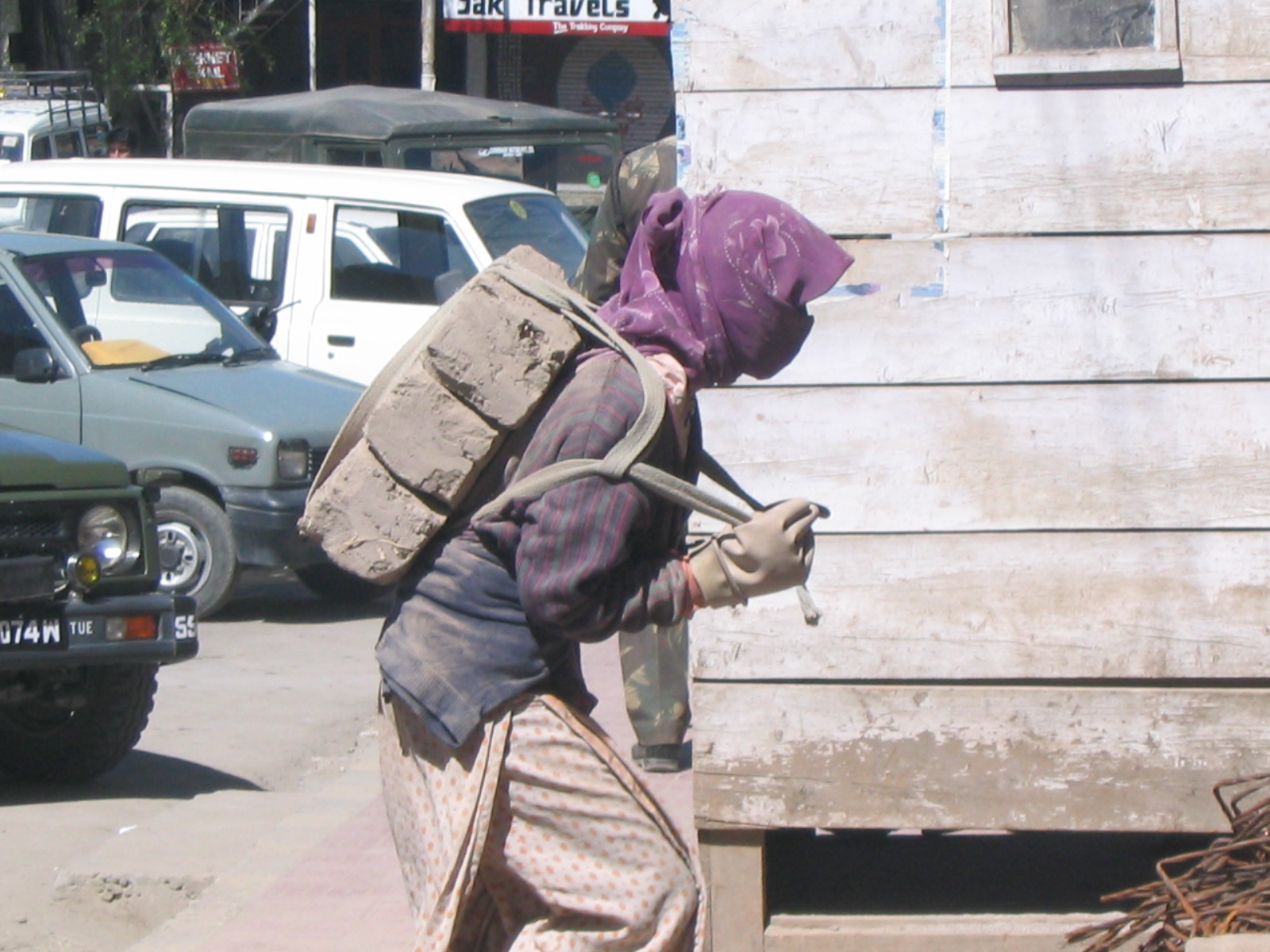
When I took the photo above I was aware I was stealing something. The woman whose life I dived into for a few moments – uninvited and unashamedly –  remains anonymous. I took the photo because at first I didn’t believe what I was seeing. I remember standing, frozen and frightened for a few moments while I gathered what my eyes were trying to capture. Across the dusty unpaved street in downtown Ladakh a woman hobbled slowly; her back bent over by the weight of the bricks it was carrying.  Her hands and face were protected by rags. Although I couldn’t see her eyes I could feel her shame. She did not look up or down. She did not glance sideways towards my direction. She knew I was there.

Here, here’s my life. Here’s my feminism. Here’s my lot. I carry cement bricks to building sites each day because where I’m from women do the hard labour. Women do not get to make decisions about make-up free selfies. Women do not get to decide about what to make for dinner, what else to put in school lunch sandwiches that become boring soon after first term ends. Women do not get to drive cars and be called arrogant bitches; or walk down streets in fancy clothes and get wolf-whistled at. Here feminism  – if that’s what you want to call women working – is meaningless for me. Do you want to be treated like a man and have your back broken?

Sometimes the mornings are so monotonous they lull me back to sleep; the morning drill. The fighting children. The rush to do everything and more. The ridiculous expectations we have of ourselves. The domestic crush of the soul. The anonymous woman in the photo finds her way back into my thoughts on these days in particular. As her image confuses and destroys everything I thought I knew her predicament challenges me in such an immense way it forces me to get up and try to make sense of all our realities as they naively collide and stupidly compete with each other. She may still be stuck in her reality. I am often stuck in mine. Yet even the thought of hers during my day-today so-called privileged life is what makes me believe that one day, somehow, our two realities will meet. Her bricks will fall, my complacency will be shaken and we will both be called women.

Gone Illuminating. Be back soon.

I have just returned from being immersed. I don’t refer to anything religious with my choice of conjugated verb.

My immersion began when I arrived in Byron Bay with one initial mission: to find the flotation tank that had set me on a cloud of care-free some fifteen years ago when I first discovered this mode of relaxation that was unlike any other I could have imagined. Lying in a coffin half-filled with salty water is not everyone’s chocolate. And think what you will for my confession that it’s my idea of heaven.

So when I found my zero gravity coffin box at a place called Relax Haven I knew it was only a matter of time before further immersion would be allowed to occur. First I needed to release the layers of fatigue, dust, dead space and worry that had edged their way under my skin and remained in the creases hoping to find a permanent home amongst my angst. As I lay down in the warm, magnesium-activated water I said ‘sorry loves, you’re leaving’ and closed my eyes for an endless hour of trying to go nowhere in my own head. For most of the hour I did manage to find nowhere. After what seemed like a period of fifteen minutes my time in the tank was over and my journey could begin.

unnamed (2)

The next three days at Byron Bay Writers Festival 2014 were filled to the brim with whole food, fine weather and full words.

I feel slowed down, filled up and let out.

Jeanette Winterson said ‘where do we meet? We meet on the steps of a story’ and in doing so reminded us all that language is what started us, language is what ties us together and language is what makes us human. It’s often so easy to forget that little line –  ‘we are all human’ – it’s so obviously simple that it’s so easily kicked away to the sidelines. She said

“If you think about language beginning in the mouth rather than before it hits the page, because speech is far older than writing, language itself becomes a memory system, a way of passing on and preserving what is essential to remember, the history of a tribe, clan, a people, enchantment, celebrations, warnings, heroism, doomed lovers, loss. In that sense storytelling allows history to happen.”

and immediately reminded us not only of our present, but of the past in all our futures. And in that complexity we find ourselves. We need to embrace the complexity and not let it scare us into unconsciousness. In slowing down and listening to the stories told all around us, we need to let our minds immerse themselves in the language that binds us.

Jeanette Winterson was one of so many writers who reminded me so gently what it means to be a reader and a writer. ‘Reading…’ she said ‘takes your hand off the panic button.’ And I had had my hand on or around that panic button for far too long. The circumstances of my life had forced me there. Now, Winterson and her words were showing me how to remove it. For that I cannot be more grateful.

unnamed (3)

At a book signing after her address Jeanette Winterson touched my heart…and I like to believe I touched hers as well. As everyone lined up with their  pile of books for her to sign, all with sticky notes attached clearly spelling the accompanying  names to make things easier for the signer there was one book that remained unnamed – mine. As she reached this book Ms Winterson asked ‘and who’s this one for then?’ I smiled shyly and said ‘that one’s for my daughter…who’s six years old.’ She looked at me with wide eyes and I explained ‘you see, I might never see you again! And so I hope that in ten or fifteen years time, when she’s old enough, that she’ll pick up your book and read it as I did.’ And as I tried to get the words out as calmly as possible, she put pen to paper and wrote a little note for my daughter. She looked up at me and I could see her eyes glimmer. Mine certainly were. I said ‘thank you so so much’ and walked away with the best gift I had received in a long time.

After Jeanette’s remarkable introduction the rest of the festival flowed on like expensive champagne, straight into my glass. Three days later I emerged, drunk, spent and reignited.

“A lot of people say they don’t have time to read any more,” she said. “That should be a warning sign, not a fact of life.” (JW)

I’m back 🙂